Restaurant SEO in Vancouver: How to Get More Visibility and Bookings
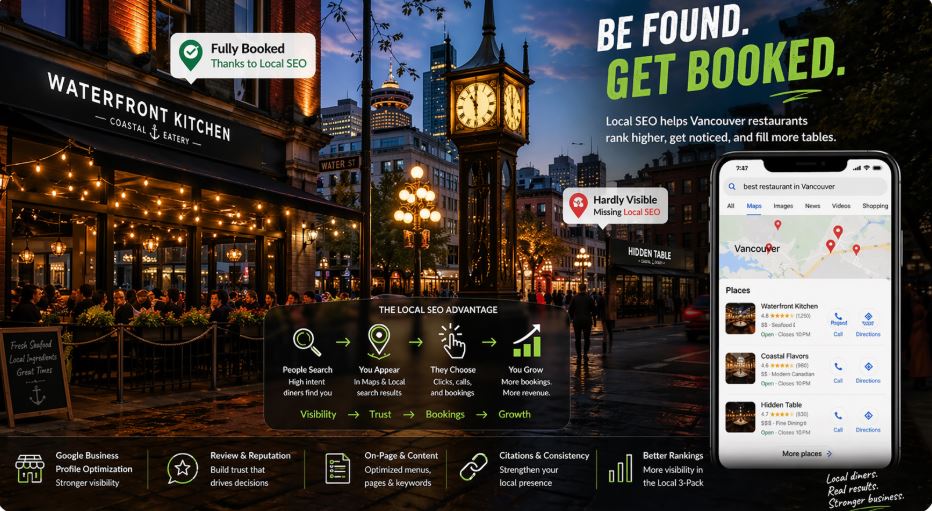
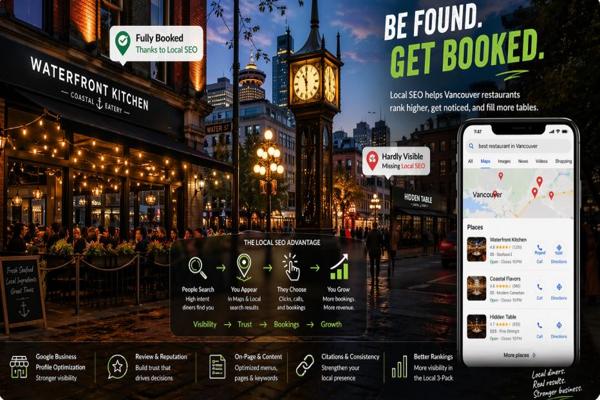
On a Friday evening in Gastown or Kitsilano, it’s easy to spot the difference — two restaurants on the same street, one fully booked before sunset, the other still waiting for walk-ins.
It’s not always about which place has better food.
More often, it comes down to which one people actually see when they search.
We’ve noticed this repeatedly while working with restaurants across Vancouver. The ones that stay consistently busy aren’t just relying on quality — they’re showing up at the exact moment someone pulls out their phone and searches “where should I eat?”
That decision happens quickly. In many cases, people compare just a few options on Google Maps, glance at reviews or photos, and choose within seconds.
That’s where restaurant SEO in Vancouver starts to matter — not as a long-term branding exercise, but as a way to show up right when someone is ready to decide.
What Is Restaurant SEO?
Restaurant SEO is the process of optimizing a restaurant’s online presence to increase visibility in Google Search and Google Maps, helping it appear for high-intent queries like “restaurants near me” or “best sushi in Vancouver.” It focuses on attracting ready-to-book customers by improving rankings, reviews, menu visibility, and reservation pathways.
Why Local Restaurant SEO in Vancouver Has Changed
Five years ago, where you were located mattered most.
If you were in a busy area, you would naturally get traffic.
Today, that’s no longer enough.
Now, intent decides visibility.
People don’t just “browse restaurants” anymore—they search with purpose. Queries like “best restaurant near me” or “open sushi Vancouver” signal immediate decision-making.
Core Restaurant SEO Strategies That Drive Rankings and Bookings
In this guide, you’ll learn:
- How restaurants improve visibility in Google’s Local 3-Pack
- How structured data can strengthen discoverability
- How Google Business Profile optimization affects bookings
- Which ranking factors matter most in competitive local markets
- Common SEO mistakes that suppress restaurant growth
- How search intent alignment can improve performance without relying on ads
How Restaurants Rank in Google’s Local 3-Pack
Restaurants rank in Google’s Local 3-Pack based on relevance, distance, and prominence, along with engagement signals like clicks, calls, and reviews.
There’s a reason restaurant owners fixate on the map results.
It’s where decision-making compresses.
A diner searches for a place to eat, sees three businesses, compares ratings, scans photos, checks whether tables are available, and makes a choice—often in under a minute.
It behaves more like an intersection of relevance, prominence, and interaction signals.
At Digital Marketing CDN, one recurring pattern shows up in restaurants that break into stronger map visibility: they improve real user signals, not just listings.
Get More Restaurant Bookings from Google
✅ Appear in “best restaurants near me” searches
✅ Get more calls, reservations & walk-ins
✅ Improve Google Maps ranking in Vancouver
✅ Turn search traffic into real customers
━━━━━━━━━━━━━━━━━━━━━━━━━━━
What actually influences stronger Local Pack performance
1. Category precision
Primary category selection often does more work than owners realize.
A business categorized too broadly may lose relevance for high-conversion searches.
Examples:
- Japanese restaurant vs sushi restaurant
- Brunch restaurant vs breakfast restaurant
- Fine dining restaurant vs steakhouse
Small category changes can alter who you compete against.
2. Query alignment
Descriptions, services, menu sections, photos, and review language often reinforce ranking relevance.
This affects discovery for searches such as:
- restaurants open now
- best lunch near downtown
- Private Dining Vancouver
- takeout restaurant nearby
- date night restaurant
These are often commercial-intent searches, not casual research.
3. Engagement Signals
Many overlook interaction patterns:
- direction requests
- calls from listings
- booking clicks
- menu views
- photo engagement
Listings that get more calls, clicks, and direction requests tend to hold their positions longer.
4. Review quality, not just review count
A restaurant with 210 detailed reviews can outperform one with 1,200 generic ratings.
Specificity matters.
Mentions of dishes, service speed, patio seating, reservations, gluten-free options, or late-night dining all create semantic relevance.
That affects both rankings and click behavior.
5. Supporting entity signals across the web
Google rarely trusts one source.
It validates businesses through corroboration.
Consistency across:
- Google Business Profile
- Yelp
- OpenTable
- TripAdvisor
- DoorDash
- Uber Eats
- Apple Maps
can strengthen trust signals tied to local discovery.
That is where many restaurants leave ranking equity on the table.
Restaurant Schema Markup for SEO (Complete Guide)
Structured data is often treated like a technical add-on.
It shouldn’t be.
It helps search engines interpret what your restaurant is, what you serve, how people can book, and why you may be relevant for specific dining searches.
Done well, a schema can improve understanding, eligibility for richer results, and click-through behavior.
Essential Schema Types for Restaurants
Restaurant Schema
Supports core business understanding:
- cuisine type
- hours
- address
- price range
- reservation links
- service options
Menu Schema
This is consistently underused.
Search engines struggle when menus live in PDFs or image files.
Text-accessible menus paired with markup can help connect dishes to search demand.
This is what helps connect your menu to dish-specific searches like
- ramen near me
- oysters’ happy hour
- vegan brunch
- wood-fired pizza
This is how dishes start appearing in search results, not just your restaurant name.
Review Schema
Useful when implemented correctly and ethically.
It can reinforce trust signals and improve the presentation of results.
Reservation Schema
Important when integrating platforms like OpenTable or direct booking systems.
Reducing friction at the booking stage matters.
How Schema Improves Search Visibility
The schema should not mirror generic metadata.
It should reinforce business positioning.
If your restaurant competes around the following:
- seasonal tasting menus
- waterfront dining
- private events
- chef-led omakase
Those differentiators should be reflected structurally where appropriate.
That strengthens entity understanding.
That is where information architecture becomes a search advantage.
Google Business Profile Optimization
Most profiles are “filled out.”
Few are actually optimized.
There’s a difference.
Use this as a working checklist:
Core accuracy
- Primary category correctly mapped
- Secondary categories reviewed
- Hours updated for holidays and seasonal changes
- Phone, address, and booking links verified
- Service attributes completed
Commercial conversion assets
- The menu is linked and crawlable
- Reservation flow tested
- High-quality interior, exterior, food, and team photos added
- Cover image aligned with positioning
Relevance enhancements
- Products or menu highlights added
- Service descriptions aligned with actual search demand
- Q&A section monitored
- Common diner questions answered
Trust signals
- Review responses maintained
- User-submitted photos monitored
- Incorrect edits are challenged quickly
- Duplicate listings checked
Discovery growth signals
- Posts used for events, specials, seasonal offers
- Popular dishes reflected in profile content
- High-intent actions tracked:
- calls
- direction requests
- bookings
For many restaurants, this is the first place customers decide whether to call or book
SEO Essentials You Must Know
| Local SEO Ranking Factors | Best Local SEO Services |
| SEO Campaign Management | Online Advertising Campaigns |
| Brand Awareness Strategies | Vancouver Real Estate Leads |
Real Case Study: Fixing Search Intent to Increase Bookings
A casual dining operator in Greater Vancouver approached Digital Marketing CDN after struggling with unstable weekday bookings.
The assumption was familiar:
“We probably need more traffic.”
That wasn’t the issue.
Traffic existed.
A mismatch existed.
What we found
The restaurant was appearing for broad discovery terms.
But it converts poorly for action-driven searches.
Problems included:
- menu buried in PDF format
- Listing emphasizing ambiance over convenience
- no dish-level search relevance
- weak optimization around lunch and takeout demand
Adjustments made
We focused on alignment.
Not volume.
Changes included:
- text-based menu restructuring
- business profile refinements
- location landing page improvements
- dish-level semantic optimization
- stronger reservation and click-to-call pathways
Observed performance changes over six months
Over six months, measurable changes included
- 38% increase in calls from business profile interactions
- 24% increase in direction requests
- 31% lift in non-branded discovery queries
- Weekday booking stability improved materially
Most important:
No paid ads were required to produce the change.
Visibility became more qualified.
That often matters more than visibility becoming larger.
Key Restaurant SEO Ranking Factors in Vancouver
Ranking factors evolve.
But certain signals appear to be compounding in importance.
Factors restaurants should watch closely
1. Entity consistency
Search engines increasingly validate businesses through corroborated entity relationships.
That includes:
- brand mentions
- citations
- platform consistency
- linked profiles
This influences citation trust.
2. Behavioral engagement
Signals tied to:
- click-through rates
- direction requests
- branded search growth
- repeat engagement
appear increasingly meaningful.
3. Menu-level relevance
Restaurants ranking well often have stronger dishes and cuisine relevance.
It is entity coverage.
4. Review sentiment quality
Not merely volume.
Sentiment.
Positive thematic patterns around:
- service
- food quality
- speed
- atmosphere
can strengthen both ranking confidence and conversions.
5. Local Citation Accuracy
Weak citation consistency still causes ranking drag.
Inconsistent listings still reduce trust and can hold rankings back.
6. Experience signals on-site
Increasingly important:
- fast mobile experience
- frictionless reservations
- useful menu architecture
- location clarity
A restaurant’s search performance is now closely tied to user experience—if the website is slow or the menu is hard to access, fewer people convert into bookings even if rankings are strong.
Common Restaurant SEO Mistakes
Some mistakes look harmless.
They are not.
They compound.
Mistake 1
Treating SEO as a one-time setup.
Search visibility behaves more like momentum.
Static strategies decay.
Mistake 2
Using image menus or PDF-only menus.
This weakens crawlability.
And often suppresses dish-level discoverability.
Mistake 3
Ignoring reservation friction.
If booking takes too many steps, rankings may still generate weak revenue outcomes.
More visitors don’t help if they don’t turn into reservations.
Mistake 4
Over-dependence on delivery platforms.
Marketplace visibility is not owned visibility.
That distinction matters strategically.
Mistake 5
Chasing generic traffic.
Broad searches can produce poor conversion.
High-intent queries often matter more.
Mistake 6
Ignoring citation hygiene.
Conflicting business data still causes avoidable trust erosion.
And many restaurants never audit it.
Why More Traffic Doesn’t Always Mean More Bookings
Most restaurant SEO advice focuses on visibility.
Too little focus on qualification.
Those are different.
Getting discovered by the wrong audience can increase traffic but reduce bookings. The restaurants that grow focus on attracting people who are ready to choose, not just browse.
How visibility in search results translates into real business outcomes like calls, bookings, and customer visits.
Restaurant SEO FAQs
How do restaurants rank in Google’s Local 3-Pack?
Restaurants typically improve Local 3-Pack visibility through stronger Google Business Profile optimization, review quality, accurate citations, category relevance, and higher engagement signals such as calls, direction requests, and bookings.
Does schema markup help restaurant SEO?
Yes. Restaurant schema can improve how search engines understand menus, cuisine types, reservations, and business information, which can support visibility and richer search results.
What is the biggest SEO mistake restaurants make?
One of the most common mistakes is treating SEO as a one-time setup instead of an ongoing process tied to changing search behavior, reviews, competition, and local ranking signals.
Can restaurant SEO increase bookings without ads?
Yes. Improved local visibility, reduced booking friction, and stronger alignment with high-intent searches can increase organic bookings without relying entirely on paid advertising.
Experience Behind These Insights
These insights are based on real-world analysis of local search performance in Vancouver. They reflect observed patterns in how businesses improve visibility, engagement, and conversions through local SEO.
Ongoing changes in search behavior shape the approach, Google Business Profile performance, and ranking signals, with regular updates to maintain accuracy and relevance.
How to Build Long-Term Restaurant SEO Growth in Vancouver
The core idea of this article is that restaurant SEO performs best when it is treated as a connected system rather than isolated tactics.
Sustainable growth in search comes from aligning key areas such as:
- local visibility in Google Maps and search results
- search intent alignment with what customers are actually looking for
- structured data that improves how Google understands your restaurant
- consistent entity signals across platforms
- review quality and sentiment
- smooth conversion paths from discovery to booking
When these elements work together, restaurants don’t just improve rankings—they build compounding visibility that strengthens over time, leading to more consistent discovery, higher-quality traffic, and increased bookings. If you’re looking to apply this approach to your own restaurant or need expert guidance, you can always reach out directly at (250) 815-5442 to discuss practical next steps.