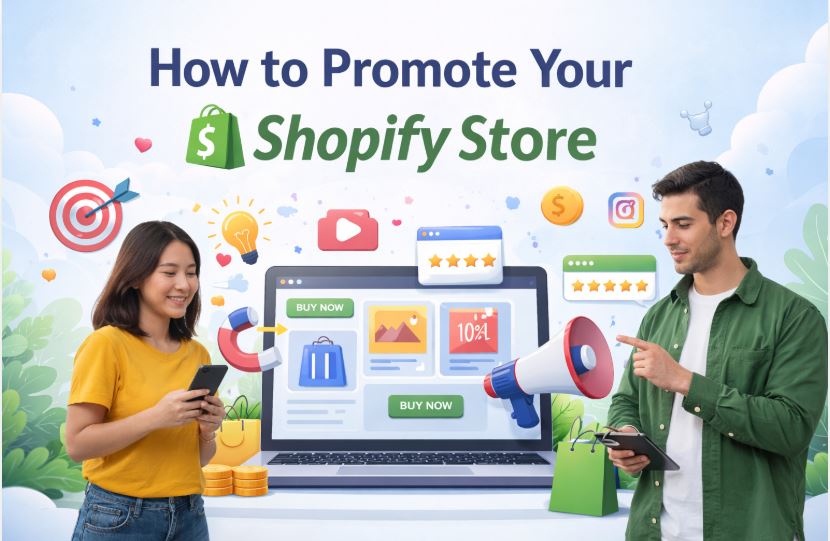
How to Promote Your Shopify Store in 2026 (Growth System That Works)
Most Shopify stores don’t fail because the product is bad.
They fail because their traffic never turns into a stable system.
You might get visitors from ads, a few likes on social media, maybe even a viral moment—but nothing feels consistent.
What separates growing stores from stagnant ones is not effort. Its structure
Across multiple Shopify stores, one consistent pattern appears—growth becomes predictable only when traffic, content, and retention systems work together.
At Digital Marketing CDN, we’ve seen that learning how to promote your Shopify store effectively—especially in competitive markets like Canada—comes down to building systems, not chasing short-term traffic spikes.
This guide introduces the Shopify Growth Loop™—a framework designed to turn inconsistent traffic into predictable revenue by aligning acquisition, conversion, and retention.
Why Most Shopify Stores Fail in 2026
Across multiple Shopify stores, one pattern shows up consistently:
Most stores focus on getting more traffic before fixing what happens after the click.
But returning visitors often convert significantly higher than new users.
Without a system to capture and nurture them, even strong traffic doesn’t turn into stable growth.
Grow Your Shopify Store Faster
✅ Turn visitors into consistent buyers
✅ Build a system that drives repeat sales
✅ Create predictable growth without relying on ads
━━━━━━━━━━━━━━━━━━━━━━━━━━━
Core Strategies to Grow Your Shopify Store in 2026
Promoting a Shopify store in 2026 isn’t about relying on a single tactic. The most effective brands combine audience building, content, and conversion systems to create consistent growth.
Below are the key strategies that work together to turn traffic into predictable sales.
Audience Building & Segmentation System
Most store owners chase traffic first.
But traffic is temporary. Attention is not.
The real shift happens when you start capturing people instead of just attracting them.
Instead of using generic popups or discount traps, the focus should be on relevance.
Someone viewing a product already tells you something. Someone returning twice tells you even more.
So instead of treating all visitors the same, smart stores shape different entry experiences:
- First-time visitors get value-based incentives, not just discounts
- Returning users see curated collections or new arrivals
- Cart visitors receive reassurance, not pressure
Once people enter your ecosystem, segmentation quietly becomes the engine behind your sales.
You’re no longer sending one message to everyone—you’re speaking based on behavior.
Email & Automation Tools Setup
- Add email capture on product pages, not just the homepage
- Use exit-intent triggers tied to browsing behavior
- Build separate flows for new, returning, and inactive users
Use the Right Tools for Automation and Capture
- Klaviyo (automation + segmentation)
- Shopify Email (basic starter setup)
- Privy (on-site capture tools)
Real-World Conversion Example
A skincare store in Canada started noticing something odd—people were coming back more than once, but still not buying.
Instead of pushing discounts to everyone, they changed how different visitors were treated:
- New visitors received simple educational emails about ingredients and product use
- Returning users were shown before-and-after results to reduce hesitation
- Frequent visitors were given early access to new products instead of discounts
Nothing drastic changed on the surface, but the approach felt more relevant to each type of visitor.
Over time, conversions improved without needing to bring in more traffic.
Social Media Marketing for Shopify Stores
People don’t open social apps to shop.
They scroll to be entertained, informed, or inspired.
Stores that win on social don’t interrupt that behavior—they blend into it.
That means your content shouldn’t feel like advertising. It should feel like something a real person would post or engage with.
Highly polished content often performs worse than raw, relatable material.
What actually works today is simple:
show the product in real life, in real situations, with real reactions.
Not studio perfection. Real usage.
High-Performing Short-Form Content Strategy
- Create short videos showing product use in daily life
- Post customer reactions instead of scripted ads
- Build content around problems, not just products
- Stick to 1–2 platforms instead of spreading thin
Content Creation Tools Stack
- CapCut (video editing)
- Canva (creative assets)
- TikTok Creative Center (trend discovery)
- Meta Business Suite (posting & scheduling)
Viral Content → Paid Ads Example
A fitness brand posts:
- real gym footage using their product
- customer transformation clips
- short “why I started” stories
Those videos later became ad creatives with strong performance because they already felt authentic.
Social Commerce & In-App Selling Strategy
The gap between discovery and purchase is shrinking.
People no longer always visit websites first—they buy where they discover.
That changes how Shopify stores need to think.
Instead of pushing users off social platforms, you meet them inside them.
Product tagging, in-app shopping, and native checkout experiences reduce friction significantly.
Reduce Friction by Selling Directly Inside Social Platforms
- Connect Shopify with social commerce tools
- Tag products inside posts and videos
- Enable direct checkout where available
- Keep product feeds updated automatically
Social Selling Tools Stack
- Shopify Social Sales integrations
- TikTok Shop Seller Center
- Meta Commerce Manager
Real Example of In-App Purchase Conversion
A beauty brand posts a TikTok tutorial.
Users tap the product tag and complete the purchase without leaving the app.
No extra steps. No drop-off points. Just direct conversion.
Influencer Marketing for Shopify Growth
Influencer marketing has changed quietly.
Big reach doesn’t guarantee results anymore.
Smaller creators often drive better conversions because their audience trusts them more deeply.
What matters now is alignment, not audience size.
A creator who actually uses your product will always outperform someone reading a script.
Micro & Nano Influencer Strategy
- Work with nano and micro creators first
- Focus on long-term collaboration, not one-off posts
- Let creators build content in their own style
- Reuse their content across ads and websites
Influencer Management Tools
- Aspire
- Collabstr
- Upfluence
- Affiliate tracking apps inside Shopify
Real Case Study: Influencer Scaling
A home decor store sends products to 15 small creators.
Instead of polished ads, they receive everyday room setups.
Those clips become:
- Instagram posts
- TikTok content
- paid ad creatives
Same content, multiple revenue channels.
Referral Systems That Grow Without Ad Spend
People trust recommendations more than promotions.
That hasn’t changed.
But modern referral programs go beyond “give a discount, get a friend.
They work better when they feel like access rather than a transaction.
Building High-Converting Referral Programs
- Offer rewards for both sides
- Add tiered milestones (not single rewards)
- Include non-monetary perks like early access or exclusives
Referral Software Stack
- Smile.io
- ReferralCandy
- Yotpo Loyalty
Case Study: Tiered Referral Growth
A fashion brand gives:
- referral 1 → discount
- referral 5 → exclusive drop access
- referral 10 → VIP membership
Customers don’t just refer—they participate.
Read More Essential Marketing Guides
How to Get Traffic and Sales on Shopify
Getting traffic is only half the equation—turning that traffic into sales is what actually grows your store. The strategies below focus on attracting the right audience and converting them through intent-driven marketing.
Paid Advertising Strategy for Shopify Stores
Advertising still matters, but the approach has shifted.
Broad targeting without intent is inefficient now.
In campaigns managed by Digital Marketing CDN, aligning ad intent with landing page messaging consistently reduces wasted ad spend and improves conversion rates.
For Shopify stores targeting Canada, ad costs on Meta and Google can vary significantly depending on niche and province.
What works is alignment between what people search, what they see, and what they land on.
Search ads perform best when they match exactly what the user wants at that moment.
Retargeting performs best when it feels like a reminder, not pressure.
Intent-Based Ad Campaign Structure
- Separate campaigns by user stage (new, returning, cart users)
- Match the ad copy directly with the landing page message
- Use retargeting for warm audiences only
- Test creatives continuously instead of scaling one ad
Paid Ads Tool Stack
- Meta Ads Manager
- Google Ads
- TikTok Ads Manager
- Triple Whale (tracking & attribution)
Retargeting Conversion Example
A user visits a product page but doesn’t buy.
Later, they see a short video showing the product in use with a subtle reminder.
They return and complete the purchase.
No aggressive selling—just timing.
Search Visibility That Builds Long-Term Growth
Search traffic doesn’t spike quickly, but it compounds over time.
Instead of chasing broad competitive terms, successful stores focus on specific intent.
That means answering real questions people already have.
Not just selling products, but explaining, comparing, and guiding.
Problem-Based SEO Content Strategy
- Build content around problems, not keywords
- Create comparison and “how-to” pages
- Optimize product descriptions naturally
- Improve site speed and structure
Use SEO Tools to Find and Structure Opportunities
- Ahrefs / Semrush
- Google Search Console
- SurferSEO (optional for structure insights)
SEO Traffic Case Study
Instead of targeting “protein powder,” a store targets the following:
- “best protein for beginners”
- “How much protein per day?”
Those users are closer to buying without being directly sold to.
The Multi-Channel Growth Model
Most Shopify stores try to scale one channel at a time.
But real growth doesn’t work like that anymore.
It happens when channels support each other:
- Social creates awareness
- Search builds trust
- Email brings people back
- Ads accelerate timing
When all four move together, growth stops being random.
It becomes predictable.
Frequently Asked Questions (FAQs)
How do I promote a Shopify store effectively in 2026?
Focus on combining audience capture, content-driven visibility, and intent-based advertising rather than relying on a single marketing channel.
What is the best free method to get traffic?
Search-optimized content and organic social engagement remain the most sustainable ways to generate traffic without ongoing ad spend.
How can I increase conversions without more traffic?
Generating…
Which marketing channel should I start with?
Begin with one acquisition channel (search or social) and one retention channel (email). Expanding too quickly reduces effectiveness.
Key Takeaways
- Traffic alone doesn’t build a business—retention does
- Authentic content outperforms polished promotion
- Smaller, trusted voices often convert better than large audiences
- Search traffic compounds when built strategically
- Multi-channel alignment creates sustainable growth
Start Growing With a Shopify Growth System That Works
If there’s one thing to understand, it’s this:
Traffic doesn’t build a business. Systems do.
When your store stops relying on a single source of visitors and starts connecting every touchpoint together, growth becomes stable instead of uncertain. That’s where real scale begins.
If you’re ready to start building a system that actually converts, call (250) 815-5442 for support.