How to Build a Content Marketing Strategy That Drives Real Revenue
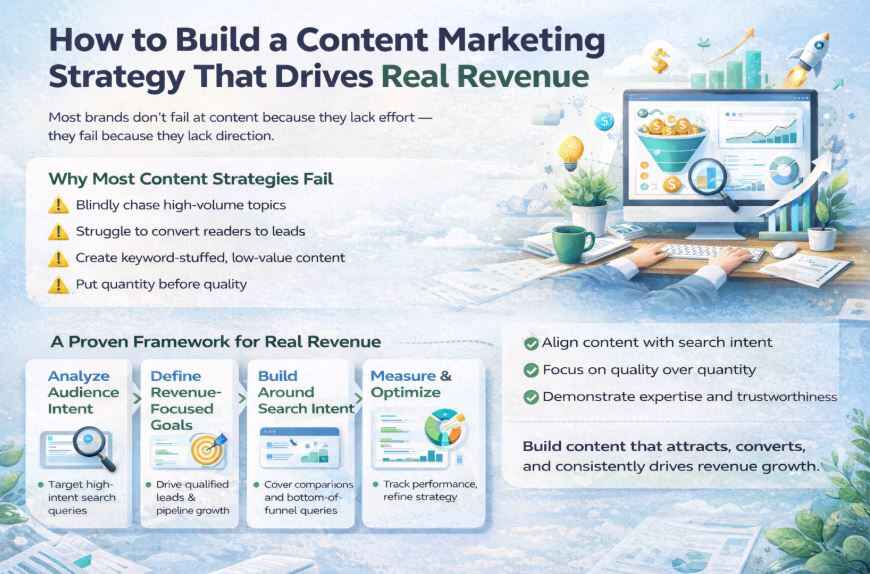
A content marketing strategy is one of the most reliable ways to attract, engage, and convert customers — but only when it’s built with a clear purpose.
Here’s where most brands go wrong: they don’t lack effort — they lack direction. Publishing content without a system is like running ads without targeting — you may get attention, but not the outcomes that matter: qualified leads, pipeline growth, and consistent revenue.
Today, search engines and AI platforms prioritize depth, relevance, and credibility over sheer volume. And audiences have become far more selective — surface-level content no longer earns attention or trust.
Most content strategies fall apart not because teams aren’t working hard, but because they don’t connect content to real business outcomes. This content framework is built to change that. Follow it, and you’ll have a clear path to turning content into consistent traffic, qualified leads, and real customers.
Turn Your Content Into Revenue Fast
✅ Attract qualified leads ready to buy
✅ Maximize ROI with high-intent content
━━━━━━━━━━━━━━━━━━━━━━━━━━━
Why Most Content Strategies Fail
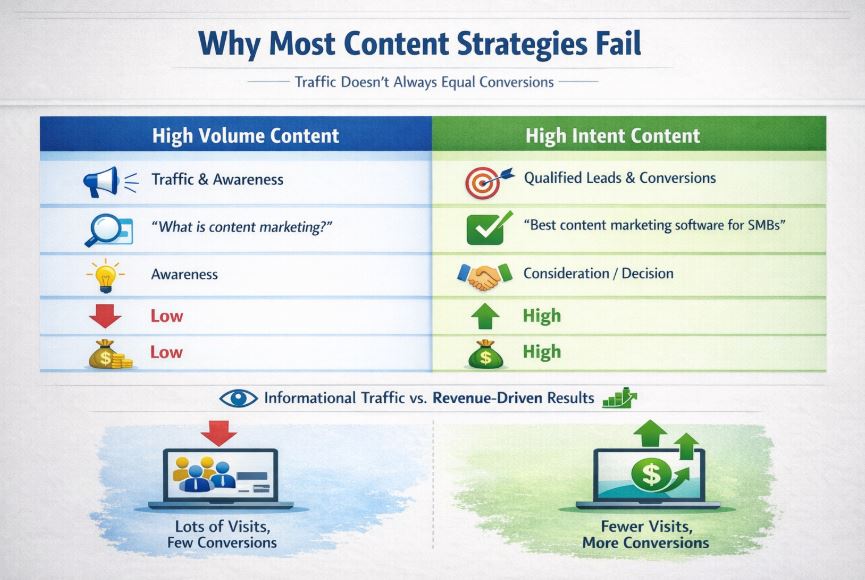
Content strategies rarely fail due to writing quality. The real issue is misaligned intent.
In many cases, businesses create informational content but expect transactional outcomes.
For example, ranking for “what is content marketing” rarely drives revenue, yet many brands invest heavily in it.
For example, many SaaS companies that shift focus from high-volume informational blogs to comparison and alternative pages often find that traffic becomes more qualified. While overall visits may decrease, the remaining audience is typically closer to making a purchase, which can lead to more demo requests and meaningful conversions.
━━━━━━━━━━━━━━━━━━━━━━━━━━━Why Most Content Strategies Fail
What is a content marketing strategy?
A content marketing strategy is a structured plan for creating, optimizing, and distributing content to attract a defined audience and convert them into customers. It aligns content with business goals, search intent, and user behavior to drive measurable results like traffic, leads, and revenue.
Analyze Real Audience Intent
Before keywords, before content formats — you need clarity on who you’re speaking to.
Skip generic personas. Instead, map decision-stage behavior:
- What triggers their search?
- What alternatives are they comparing?
- What objections slow them down?
High-performing content today aligns with intent signals, not just demographics.
For example:
- A SaaS founder searching “best CRM for small teams” is closer to purchasing than someone reading “what is CRM?”
- A marketing manager looking up “content ROI benchmarks” is likely preparing for budget approval
When you understand context, your content naturally becomes more persuasive.
Define Revenue-Focused Goals (Not Vanity Metrics)
Traffic alone is a misleading KPI.
Strong strategies tie content directly to revenue signals:
- Pipeline contribution
- Demo requests
- Qualified inbound leads
- Cost per acquisition from organic channels
According to recent industry benchmarks, companies with documented content strategies generate 3x more leads while reducing acquisition costs by up to 62%.
That’s the difference between content as an expense and content as an asset.
Build Around Search Intent
Traditional keyword research is no longer enough. Modern SEO blends:
- Search intent
- Semantic relationships
- Contextual relevance
Instead of chasing isolated keywords, structure your strategy around intent clusters:
- Commercial Intent: “Best email marketing software for e-commerce.”
- Transactional Intent: “Buy CRM subscription.”
- Informational Intent: “How to improve lead conversion rate.”
This layered approach improves both rankings and conversions.
Most SEO strategies overprioritize informational keywords because they’re easier to rank.
But in competitive markets, revenue growth often comes from targeting high-intent, lower-volume keywords that competitors ignore.
The Revenue-First Content Model
Most content plans start at the top — broad topics, high search volume, and the hope that some of that attention eventually turns into business.
That approach keeps teams busy, but it doesn’t always move things forward.
A more effective way to structure content is to begin where decisions are already happening, then work outward.
Stage 1: Capture demand
Focus first on the searches people make when they’re close to choosing — comparisons, alternatives, and specific use cases. These pages don’t always bring the most traffic, but they bring the right kind.
Stage 2: Support decisions
Once that interest is there, the next step is to remove hesitation. This is where case studies, detailed breakdowns, and clear explanations of outcomes start to matter. People aren’t just looking for information at this stage — they’re looking for reassurance.
Stage 3: Expand reach
After that foundation is in place, it makes sense to invest in broader topics. Educational content helps you reach new audiences, but it works best when there’s already something in place to guide that attention toward a decision.
A lot of teams flip this order. They build traffic first and try to figure out conversions later.
That usually leads to a disconnect.
When content reflects how people actually evaluate and choose, the path from interest to action tends to be much more direct.
Create Topic Clusters for Authority
Search engines now evaluate topical authority, not just individual pages.
A strong structure looks like this:
- One pillar page (broad, high-value topic)
- Multiple supporting articles (deep dives, use cases, comparisons)
- Strategic internal linking
For example:
A pillar on “Content Marketing Strategy” supported by:
- ROI measurement guides
- Content distribution frameworks
- Conversion optimization tactics
This structure helps search engines understand expertise — and keeps users engaged longer.
Develop a Scalable Content System
Consistency matters, but structure matters more.
Instead of randomly scheduling posts, create a content production system:
- Clear themes for each month
- Defined funnel stages per piece
- Pre-planned distribution paths
High-performing teams often follow a 70-20-10 model:
- 70% evergreen, intent-driven content
- 20% trend-based or reactive content
- 10% experimental formats
This balance ensures both stability and growth.
Optimize Content for Human Engagement
Search engines have evolved — and so has content quality.
What works now:
- Clear structure and readability
- Strong opening hooks
- Real examples and practical insights
- Natural keyword usage
What doesn’t:
- Over-optimization
- Keyword stuffing
- Generic, surface-level explanations
Content that holds attention signals quality — and quality drives rankings.
Explore More Insights
| Content Writing Services | Boost Website Traffic |
| Brand Awareness Strategies | Toronto Content Writing Services |
| B2B Lead Generation | Website Marketing Strategy |
| Link Building Services | Email Marketing Strategies |
Repurpose Content Across Formats
One idea should never live in one place.
Top-performing brands extend content into multiple formats:
- Articles → short-form videos
- Research → LinkedIn insights
- Guides → email sequences
This approach increases reach without increasing workload.
It also aligns with how modern audiences consume information — across platforms, not in silos.
Integrate Distribution From Day One
Publishing is just the starting point.
Effective strategies include built-in distribution:
- Email newsletters targeting segmented audiences
- Social content tailored for each platform
- Strategic partnerships and collaborations
Brands that actively distribute content see up to 5x higher engagement compared to “publish-only” approaches.
Build Authority With Strategic Backlinks
Search engines still rely heavily on trust signals.
High-quality backlinks from relevant, authoritative sites:
- Improve rankings
- Increase referral traffic
- Strengthen brand credibility
Relevance matters far more than sheer volume
Guest contributions, partnerships, and data-driven content consistently outperform mass outreach tactics.
Track Performance That Matters
Not every piece will perform — and that’s expected.
Focus on identifying patterns:
- Which topics convert best
- Which formats retain attention
- Which channels drive qualified traffic
Update, refine, and expand winning content.
In many cases, updating existing content can increase traffic by over 100% without creating anything new.
Optimize Content for AI Discovery
Search visibility no longer ends with traditional rankings. A growing share of users now get answers directly from AI-generated summaries before they ever click a link.
If your content isn’t structured for that layer, you’re invisible in a large part of the discovery process.
To improve visibility in AI-driven results:
- Answer key questions early and clearly within sections
- Use direct, concise statements that can be easily extracted
- Structure content with clean subheadings and logical flow
- Reinforce topics with related concepts instead of repeating the same phrase
Content that performs well in AI systems tends to be:
- Easy to interpret
- Context-rich
- Written with clarity, not complexity
This isn’t about optimizing for algorithms — it’s about making your content easier to understand, summarize, and trust.
And the easier it is for machines to interpret, the more often it gets surfaced to users.
Stay Consistent to Compound Results
Content is a long-term asset.
The brands dominating search today didn’t get there overnight — they built momentum over time.
Data shows that most content-driven growth curves accelerate after 6–9 months of consistent publishing.
Short-term thinking kills long-term gains.
Turn Strategy Into Scalable Growth
Building a high-performing content engine requires more than good writing. It requires alignment across SEO, distribution, and conversion strategy.
Brands that apply this approach consistently see measurable gains. In several cases, shifting content strategy toward intent-driven pages reduced acquisition costs while increasing lead quality within months.
That’s where Digital Marketing CDN comes in.
They focus on:
- Developing conversion-focused content strategies
- Creating search-optimized, intent-driven assets
- Scaling organic growth without wasted spend
The goal isn’t just more content — it’s better outcomes from every piece you publish.
FAQs
1. How do I start a content marketing strategy that actually works?
Begin by identifying your audience and their biggest challenges. Set clear business goals for your content, prioritize high-intent topics, and establish a consistent publishing schedule. Each piece should educate, engage, or move readers toward an action.
2. What metrics show if content is delivering real results?
Measure outcomes that matter most: leads generated, conversions, engagement per page, and contribution to your pipeline. Traffic alone doesn’t show impact—track what drives business results and informs future decisions.
3. Which type of content converts best?
Content that solves a clear problem and aligns with buyer intent converts best. Case studies, solution guides, and product comparisons help prospects move from consideration to decision.
4. How long does it take for content marketing to show impact?
Early results may appear in 3–6 months, but meaningful growth usually requires consistent publishing and promotion over 6–12 months. Content compounds over time, so patience and measurement are key.
5. How do I make content stand out in a crowded market?
Provide insights your competitors don’t, support claims with data or examples, and organize content for easy scanning. Clear structure, actionable advice, and attention to audience needs make content both discoverable and memorable.
The Bottom Line on Creating Effective Content
Content marketing still works — but only when it’s intentional and strategically aligned. The brands winning today aren’t producing more material; they’re producing smarter assets: pieces that align with real user intent, are backed by data, and build long-term authority.
When your strategy connects audience insights, search behavior, and business goals, growth becomes predictable. Every piece should move your audience closer to a decision while reinforcing your brand’s expertise.
If you’re ready to turn your efforts into measurable results, start today — or give us a call at (250) 815-5442 to discuss a strategy that drives real revenue.